


October 13, 2026
Opening Remarks & Introduction — 2026 Templeton Prize Ceremony
Share This Story


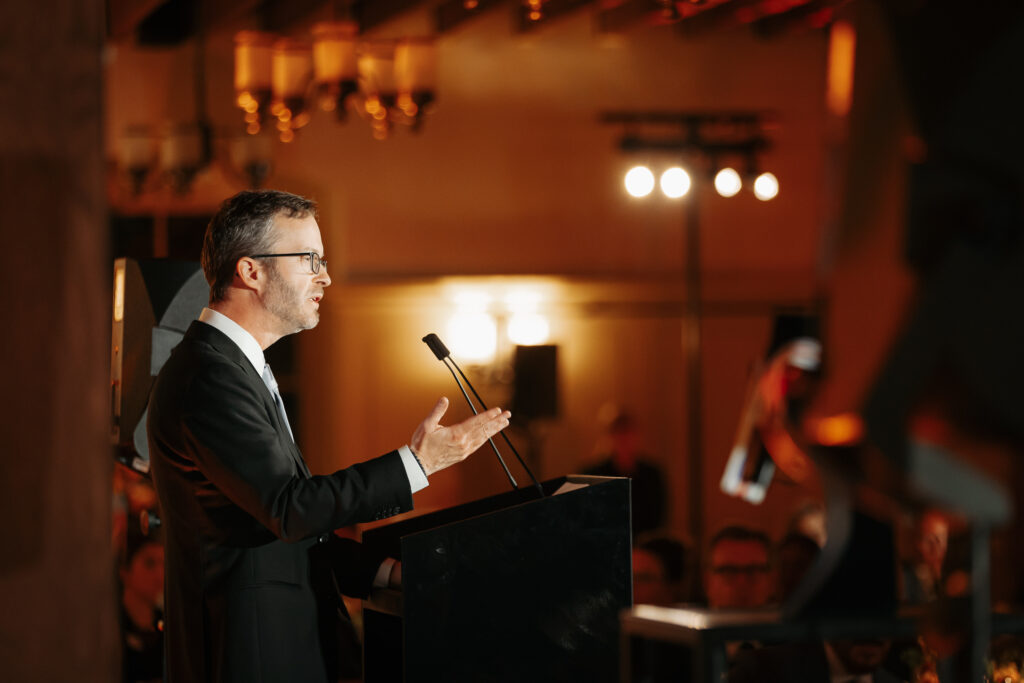
Address by Dr. Timothy Dalrymple, President & CEO, John Templeton Foundation
September 4, 2026 | Tower of London
Former Templeton Prize laureates, Lord Martin Rees, Professor Paul Davies, Templeton Prize judge Makoto Fujimura, and to you, all of our distinguished guests,
On behalf of the John Templeton Foundation, the Templeton World Charity Foundation, and the Templeton Religion Trust, welcome to the 2026 Templeton Prize ceremony.
It was Prince Philip who presented the first Templeton Prize to no less a figure than Mother (and now Saint) Teresa of Kolkata at Guildhall in 1973. Thus began a long relationship between the Duke of Edinburgh and the Templeton Prize. From 1973 to 2011, London hosted Templeton Prize laureates at ceremonies like this, including some of the world’s great scientists such as Freeman Dyson and Lord Martin Rees, religious leaders such as the Dalai Lama and Archbishop Desmond Tutu and Rabbi Lord Jonathan Sacks, and many other writers and scholars and leaders whose insights transformed their disciplines and posed new questions for all of us to ponder.
We are here to renew our warm relationship with the United Kingdom and to honor this year’s Templeton Prize laureate, himself a product of the English countryside and some of your finest academic institutions. Since Simon Conway Morris is a Brit through and through, we thought we might meet at a castle, have a bagpiper, and have a children’s choir, in order to make a ceremony more British than which none could be conceived. We nearly served bland food and warm beer but considered that might be taking matters a little too far.
And we are delighted to host you in this extraordinary location. The castle was founded by William the Conqueror in 1066 and the White Tower, where we just held our reception, is the oldest stone keep in England. As previously mentioned, the Tower hosted the first royal astronomical observatory and the great Isaac Newton served as Warden of the Mint. The list of kings and queens, princes and princesses, and world-historic persons who have trod these stones is far too long to tell now. The Tower of London has served at various times as a fortress, a palace, a prison, a treasury, and a zoo populated with a menagerie of exotic animals. Which serves as the better metaphor for tonight’s event, we shall ask you in the follow-up survey.
It would be hard to imagine a more iconic location or one more redolent of the complex and tangled human history we share – how we are still sorting out what it means to be human and what it means to be humane. We are steeped here in the long and painful, sometimes bloody and oftentimes beautiful story of human progress, and we are honored to add to the tale of the Tower tonight in our own modest way.
The Templeton Prize was Sir John Templeton’s first significant philanthropic venture. He was sixty years old and already a renowned contrarian investor when he decided to establish the Prize. On behalf of all of us, on behalf of those who have been privileged to serve the prize ever since, and on behalf of the laureates, I want to express honor to the legacy of Sir John Templeton and gratitude to the Templeton family that has stewarded that legacy with such faithfulness, wisdom, and grace.
It bothered Sir John that so many of his close friends and colleagues viewed religion as sclerotic and backward-looking. It also bothered him that religion too often has been sclerotic and backward-looking. He established the Templeton Prize for Progress in Religion to identify and encourage paragons of advancement in our understanding of transcendent things. Many of the early recipients were religious leaders, humanitarians, and theologians – people like Billy Graham, Alexander Solzhenitsyn, and T. F. Torrance.
But the emphasis of the prize and even its name shifted during Sir John’s lifetime. He increasingly emphasized that scientists should be candidates for the Prize. Science is always pursuing new ideas, testing assumptions, developing new methodologies, and making discoveries that reshape how we understand the world. As the aforementioned Templeton Laureate Freeman Dyson said, “Science is not a collection of truths [but] a continuing exploration of mysteries.”
Sir John believed that science, more than any other discipline, would contribute to the spiritual progress of all humankind and he encouraged nominators to identify scientists whose work addresses fundamental questions about human meaning and purpose.
Perhaps another way to put this is to say that the universe is filled with dazzling questions. Sir John Templeton loved the perpetual human quest of pursuing those questions and he loved the men and women who pursued them with rigor and creativity and insight. He believed that people of any faith and people of no faith at all should exercise the curiosity and humility to live those questions boldly and receive and ponder what the scientists and the sages have to say. So Sir John set the Prize amount higher than the Nobel Prizes, believing that progress in this area is, quote, “more important than progress in any other area or even in all other areas combined.”
To that end, we describe the Prize as follows: “The Templeton Prize honors individuals whose exemplary achievements harness the power of the sciences to explore the deepest questions of the universe and humankind’s place and purpose within it.” Laureates are recognized for their cumulative body of work and for the impact of their field-changing ideas.
The 2026 Templeton Prize laureate, Professor Simon Conway Morris, has produced meticulous scientific research that bears profound philosophical implications. A groundbreaking evolutionary paleobiologist from Cambridge University, he is internationally renowned for pioneering work on the Cambrian explosion and his analysis of the Burgess Shale in Canada. His most distinctive contribution has been the articulation and empirical substantiation of what is now called evolutionary convergence—the way in which the conditions for survival bend the arc of evolution toward a shared set of biological forms and behaviors. Conway Morris’s work shows how it is the case, and how thoroughly it is the case, that vastly different evolutionary lineages, separated by hundreds of millions of years, evolve toward the same solutions.
Convergence suggests that the possible outcomes of evolution are not random but constrained. To paraphrase the renowned Dr. Ian Malcolm in Jurassic Park, “Life finds a way, but it seems to find ways that lead in the same direction.” It may be that the organisms we see today in all their diversity and creativity, including something like the human organism, with the kind of intelligence to develop sophisticated languages and technologies, would emerge no matter how often we re-ran the evolutionary clock. In fact, if we were to stumble upon another planet suitable for life, then the set of life forms we find could well be strikingly similar to our own. Our story, or something like it, is, you might say, written into the natural order.
Professor Conway Morris is careful to distinguish this from Intelligent Design, which posits supernatural intervention where natural explanation is lacking. Rather, according to his work, life itself and even human life come about not in spite of natural law but because of it. The person who believes in a God might see this not as divine intervention but divine intention. The person who does not believe in a God might nonetheless feel awe and wonder that the universe we inhabit is in some sense biophilic, a lover of life. Perhaps we are not a cosmic accident so much as a cosmic inevitability.
With Professor Simon Conway Morris’s work, we may be closer today to an answer for the ancient questions of how and from whence we came to be.
This is why he is the 2026 Laureate for the most interesting prize in the world. And as you will see over the course of this evening, his work has opened up new questions around the nature and future of intelligence, as one of those evolutionarily convergent traits, as well as the search for intelligence elsewhere in the universe. You will find an extensive list of his many accomplishments and awards in your program.
Soon we will invite you to enjoy your dinner and the friends and colleagues at your table. Following dinner, and a brief word from one of the Yeoman Warders, we will have the conferring of the prize upon the 2026 Laureate. Then Professor Conway Morris will deliver the Laureate’s address and engage in a dialogue with the science writer, author, and media host, Philip Ball, who worked for over 20 years at Nature.
First, however, before dinner, we will share a video about Professor Conway Morris called Patterns of Life. It includes footage of his lovely wife Zoë and his adorable dog Dora. We are delighted to have Zoë with us this evening. Upon learning that it was once possible to pay for entry to the Tower of London zoo by bringing a dog to feed the lions, Dora declared that she did not feel quite her best and would take her evening at home.
Welcome to a memorable night. We are very glad you’re here.