


October 13, 2026
Laureate Address — 2026 Templeton Prize Ceremony
Share This Story


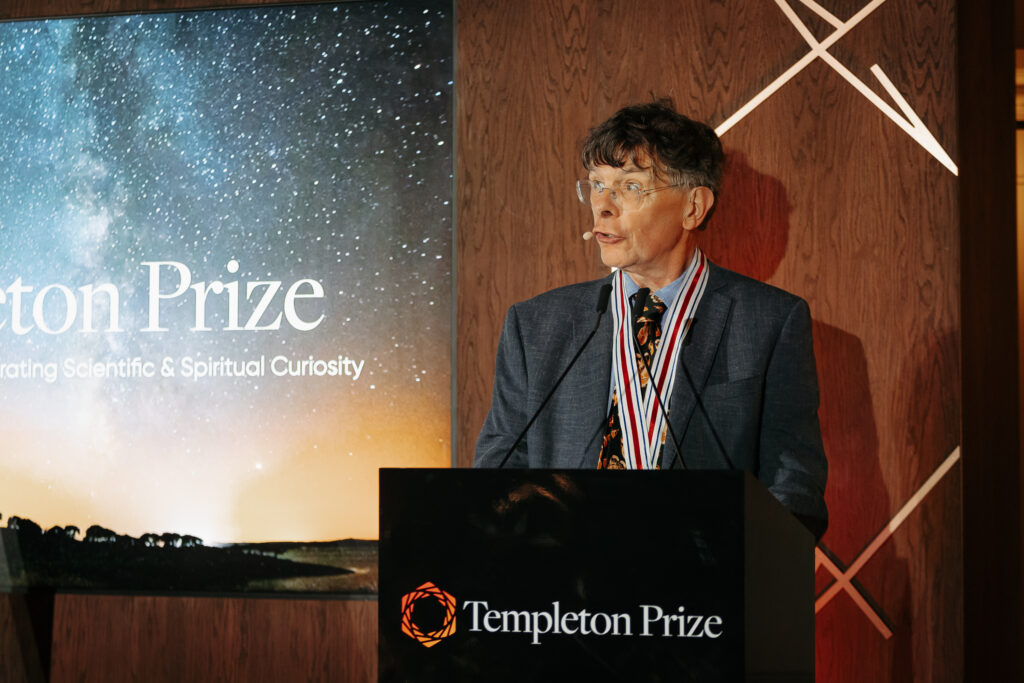
Address by Professor Simon Conway Morris, 2026 Templeton Prize Laureate
September 4, 2026 | Tower of London
Does anybody not know the opening line of Charles Dicken’s A Tale of Two Cities? “It was the best of times and…”
For me, today, it is the best of times; I have just won a Prize. So, thank you to the Templeton philanthropies.
Might I review briefly how I ended up in the Tower of London? As a post-graduate I had great good fortune to work on the Burgess Shale. And in Cambridge visiting my future supervisor, Harry Whittington, he growled “well, there are the worms…” What a cavalcade of new forms and with Brown’s Scientific Words to hand I was ready to baptize all these new forms: the now notorious Hallucigenia and Odontogriphus, a Greek cognomen for “Toothed Riddle.” In those early days, along with Stephen Jay Gould, I thought that such was the apparently dazzling diversity of the Burgess Shale animals, that over the next half-billion years the trajectories of evolution were open-ended. Another time: no tulips, no humans.
Then, oh dear! I changed my mind. No longer dream-like and now the right way up Hallucigenia turned out to be a sort of arthropod and Odontogriphus a mollusc. Old friends in disguise. One by one the so-called “Weird Wonders” were shepherded into known groups. It looked as if Gould’s “Rerunning the Tape of Life” would lead to a world little different from the one around us.
Much more intriguingly it became clear to me that the number of biological solutions was not small but an infinitesimally minute fraction of all possibilities. The evidence? The ubiquity of what we call evolutionary convergence. Darwin hardly mentions convergence and I think for very interesting reasons. After all, is not On the Origin of Species fundamentally an attempt to cripple Special Creation and destroy once and for all William Paley?
Others, however, realized the importance of convergence. Amongst these was Darwin’s opponent St. George Mivart (whom Darwin loathed) and in the next century the Soviet biologist Lev Berg. On convergent forms I could give you a myriad of examples. Here is one with which I do not doubt you are entirely familiar. It is the truly remarkable similarity between the structure of the myelin sheath and algal thylakoids. Doesn’t ring a bell? If not, consider the extraordinary convergence between the camera-eyes of humans and octopuses.
My first book on this area, Life’s Solution, entitled so as to guarantee its place on the self-help shelves of Waterstones, pointed out an interesting consequence of convergence. If intelligence and so forth are evolutionary inevitabilities, then scattered across the Milky Way on those billions of Earth-like planets, human-like species should be abundant. But the so-called Fermi Paradox (“Where are they?) suggests otherwise. One cardinal problem is that many solar systems, such as the famous Trappist-1, predate ours by billions of years. Is it not likely that we would have been colonized in the Cambrian, our ancestors (we call them Pikaia) neatly arranged on buttered toast with a stunning Montrachet to hand?
And despite my enthusiasm for convergence, an equally severe difficulty is emerging. That is, I do not doubt I am a descendant of the Miocene apes (indeed early in the morning…). Yet, paradoxically Darwin’s insistence that the differences must be one of degree rather than of kind look increasingly implausible.
Evolutionary continuity remains unchallenged but the more interesting question remains. How have we discovered the abstractions we label as mathematics, technologies and most vital of all language?
To animals these are closed books because they never tell stories. We are not only Homo sapiens but Homo narrans. How can I persuade orthodox Darwinians, even tonight safely snoozing in Oxford and Cambridge, to abandon their world-picture? Let me give you an apparently trivial example.
Many animals are social and indeed show convergences such as the fission-fusion societies of chimpanzees and dolphins. When reunited after being separated they greet each other effusively. But no animal ever says “Farewell.” Animals can certainly retrieve hidden objects. But the future per se does not exist. Similarly animals can certainly judge the reactions of others, but never can they see the world through their companion’s eyes. No animal could ever be an actor. Animals are blameless, incapable of spite or revenge, innocent of justice. It would serve little purpose to list the many differences that Tom Suddendorf calls The Gap, other than perhaps to mention that animals learn but never teach. They often use tools but never use one tool to make another.
I hinted above that humans have discovered, or more likely have been invited into, completely new worlds. As a failure as either a mathematician or a poet (distant cheers again…), let me take an alternative approach and return to Dickens.
Harry Stone, an American critic, reminds us that, at heart, the stories of Dickens are fairytales. They are not episodes of whimsy and uncertainly dressed elves, but stories that touch on the marvellous and beautiful. It is no accident that one of Dicken’s greatest admirers was G. K. Chesterton, a man of extraordinary wisdom and prescience. If in doubt read his The Flying Inn. And, like Dickens, Chesterton saw the world through supernal eyes.
It is no surprise that Chesterton influenced two of other my other heroes, the Inklings C. S. Lewis and J. R. R. Tolkien. For these three writers, and so by inspiration myself, the crux of being human is not only our rationality (again invisible to animals) but our imaginative powers that actually underpin all our science and, more importantly, offer us heart-breaking glimpses of deeper realities. Tolkien affirmed that these imaginative powers are the splintered light of God’s creation. They can still reenchant our world. And as Lewis insisted: “Reason is the natural organ of truth, but imagination is the organ of meaning. Imagination, producing new metaphors or revivifying old, is not the cause of truth, but its condition.”
Too often we forget language is never literal, but metaphorical.
Tolkien, of course, was absorbed by languages, from Gothic to Sindarin. He was much influenced by another remarkable Inkling, Owen Barfield, whose ideas on the origins of language and the evolution of consciousness are far removed from any Darwinian agenda. Steeped in language what, I wonder, would Tolkien or Barfield have made of AI and Large Language Models, the LLMs? I suspect that they would have returned to that opening line of Dickens “and the worst of times” and more than likely made some more pungent observations. Enthusiasts for LLMs will point to things achieved and future prospects: new materials, medical diagnostics, novel molecules, but I suggest you be careful what you wish for.
In my opinion LLMs are deeply sinister. Consider that even the creators of the algorithms don’t really understand how their systems work. LLMs are designed, of course, to fool you into thinking you are having a conversation. But LLMs exhibit a reckless disregard for truth, an utter indifference as to how things actually are. Seemingly fluent in language LLMs are actually easy to sabotage with linguistic tricks such as Leets and Sluicing; challenges that humans effortlessly surmount. But LLMS are deliberately seductive. Like Saruman they whisper to the vulnerable enticing solutions. So too in the academic world LLMs are leaving a trail of destruction.
The result is so poisonous because we come to be the tools of the algorithms. The Swedish thinker Carl Öhman argues that as we surrender to what appears to be an infinite authority of the LLMs so they become our gods. This is submission, and by such abrogation we outsource what should be the basis of human trust and engagement.
Equally alarming, confidence in a knowable past is destroyed. Amongst others, in his book Against the Machine Paul Kingsnorth has suggested that in AI lurks something demonic. I think Tolkien would have seen that. And a passing thought: reading chunks of AI text, mind you from the comparative safety of the journals, I am struck how similar they are in tone to the dialogues of spiritualists and other mediums. You know the stuff. Disembodied voices murmuring “Paul sends his best wishes but Maggie cannot come today…” All vaguely convincing, somehow trivial and disconnected, vaguely parasitic. I wonder if there is a deeper connection between these ethereal musings and LLMs? Perhaps parallel worlds of delusion?
Earlier I mentioned in passing C. S. Lewis. Amongst other things he was an authority on John Milton. So too was his close friend and co-Inkling, Charles Williams. In January 1940, lecturing on Milton in Oxford, he observed in the context of a Satan swollen with pride and disdain that “Hell is always inaccurate.” Given Williams series of “spiritual shockers” such as the remarkable Many Dimensions, my hunch is that he too would have regarded LLMs as inaccurate and malign.
No machine will ever be conscious, and not because we presently lack the necessary technology. Just as LLMs have no understanding of language, so their operation is utterly different from our brains. Humans construct algorithms but they themselves are not algorithmic. What we actually are is deeply mysterious but writers such as the Italian physicist Federico Faggin offer tantalizing insights. Perhaps this is a topic of interest to the Templeton philanthropies?
So, let me reiterate my thanks. To the Templeton philanthropies, of course, for their generosity, to everybody else who gave their time to be here, and to a couple of names: Zoë for all her love, our families, and Mike and Marilyn Bowers.